
LIDAR Mapping of a Rural Road Corridor
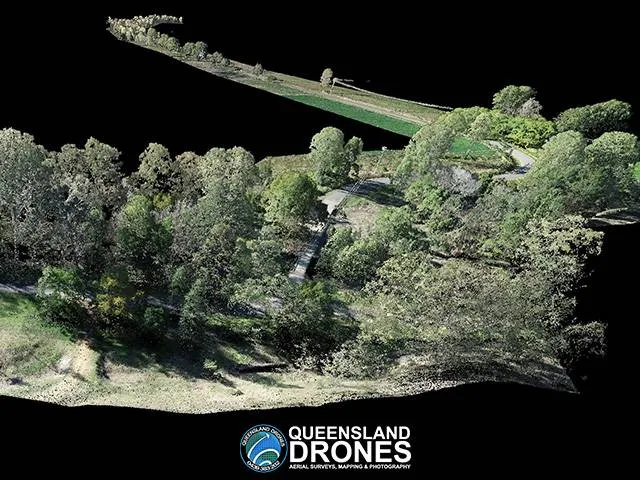
Queensland Drones mapped more than 10 km of rural road corridors with drone LiDAR for a registered surveyor on behalf of a Queensland local council, delivering a 3D model and orthomosaic at better than 2 cm RMSE.
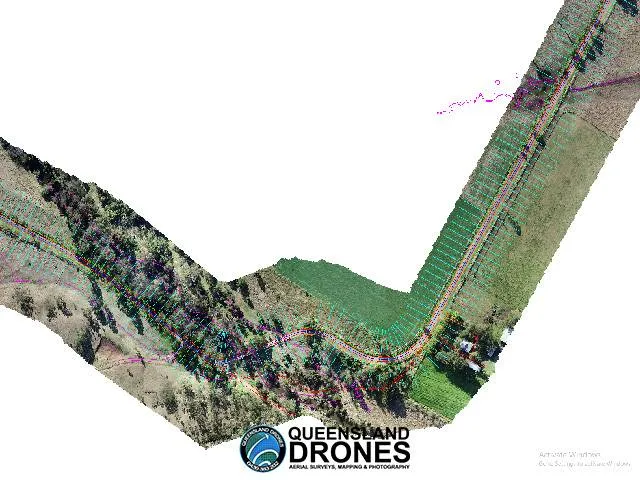
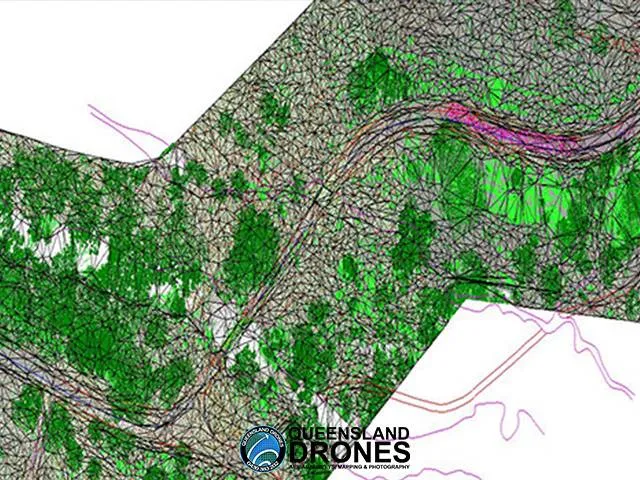
We worked with one of our traditional surveyor partners, who measured our GNSS base position and ground control points. The surveyor received a full CAD-ready terrain package: point cloud, breaklines, TIN mesh, cross-sections, ground-classified DEM and 25 cm contours.
| Project facts | Detail |
|---|---|
| Client | Local council in Queensland, through a surveyor partner |
| Project type | Rural road corridor survey and digital twin for engineering design |
| Corridor length | More than 10 km of rural roads across several sections |
| Capture method | Drone LiDAR with integrated RGB camera, PPK positioning |
| Survey control | GNSS base location and all ground control points measured by the surveyor partner |
| Accuracy achieved | Less than 2 cm RMSE |
| Contour interval | 25 cm |
The Challenge
The council’s engineers needed accurate levels and features along several kilometres of live rural road, much of it running through heavy tree cover.
A road redesign depends on knowing the existing pavement, shoulders, table drains, culverts and batters to within a few centimetres. On rural roads, that information sits along narrow corridors that are slow and risky to survey on foot.
- Traffic. Ground survey crews working along a live road need traffic control and spend hours exposed to passing vehicles.
- Length. At around 100 points an hour, a ground crew would need several days per section to capture enough detail for design and would still only have levels where they stood.
- Tree cover. Large sections of the corridor run under dense canopy, including Chinese Elm trees, running beside gullies and creek crossings. Camera-based drone mapping can’t see the ground there; LiDAR can reach it through gaps in the canopy.
Methodology
Precision came from the survey control, not the drone alone. Our surveyor partner measured the location of our GNSS base station in each road section and every ground control point, so the LiDAR data was tied to survey-grade positions from the start.
- Control by the surveyor. For each section, the surveyor measured the GNSS base location and all ground control points along the corridor. GCPs were placed every 300m along the route, on both sides of the road.
- Corridor flight planning. Flight lines were planned along each road alignment, wide enough to capture the shoulders, table drains, batters and adjoining fence lines. Corridor width, as specified by the surveyor, was 100m either side of the road centreline.
- LiDAR and RGB capture. We flew each section with LiDAR and an integrated mapping camera together, so the point cloud is colourised and the orthomosaic lines up exactly with the 3D data. Survey crews didn’t need to stand on the road to collect levels.
- In-house processing. Our GIS team processed everything ourselves — no cloud platforms, so no data was sent offshore. The point cloud was manually classified to separate ground from trees, vehicles and structures.
- Feature extraction. Road edges, centrelines, drains, culverts and other features were traced as breaklines and planimetric linework.
- Engineering products. The ground surface was turned into a breakline-constrained TIN mesh, cross-section profiles 10m intervals along the road, a ground classified DEM and 25 cm elevation contours.
Deliverables
Our surveyor partner received seven CAD- and GIS-ready products, all built from the same validated LiDAR surface so they agree with each other.
| Deliverable | What surveyors used it for |
|---|---|
| 3D colourised and classified point cloud | Checking any feature in 3D, measuring heights and clearances |
| High-resolution 2D orthomosaic | Visual base for design drawings and asset identification |
| Features and breaklines | Road edges, drains and grade changes for the design surface |
| Breakline-constrained TIN mesh | Existing-surface model for civil design software |
| Cross-section profiles | Road crossfall, shoulder and drain shape at regular chainages |
| Ground-classified DEM | Bare-earth levels for drainage and overland-flow analysis |
| 25 cm elevation contours | Grading, drainage and earthworks planning |
Validation
The finished 3D model and orthomosaic achieved less than 2 cm RMSE against the surveyor’s measured control.
RMSE (root mean square error) combines every measured difference between the model and the surveyed points into one figure, so it reflects the whole dataset rather than a single best point.
That result sits at the top of what drone LiDAR can deliver. For comparison, these are the accuracy tiers we normally quote – actual results depend on terrain, ground surface and ground cover.
| Ground control used | Typical horizontal accuracy | Typical vertical accuracy |
|---|---|---|
| None | ~5 cm | ~10 cm |
| Basic ground control | ~3 cm | ~5 cm |
| Ground control checked by a registered surveyor | ~2 cm | ~3 cm |
| This project | <2 cm RMSE |
The hard, open surface of a sealed or gravel road helps – it gives the LiDAR a clean, well-defined ground return and gives the surveyor stable and easily accessible points to check against.
Outcomes
Our surveyor partner received a complete, survey-controlled digital twin of more than 10 km of road, ready to design from, and used it as a baseline for road redesign.
- Less time on the road: Potentially saved several days or more of surveyor ground time.
- Safer: Levels are derived from the air, so survey crews spent far less time working with live traffic.
- More information: the whole corridor was captured, not just the points a crew could reach, so engineers can cut new cross-sections later without going back to site.
- Surveyor-backed: the surveyor partner’s control means the data meets the standard the council’s engineers expect.
Frequently Asked Questions
How accurate is drone LiDAR for road surveys?
On this project, drone LiDAR tied to surveyed control delivered better than 2 cm RMSE across more than 10 km of road. As a general guide, drone LiDAR achieves around 3 cm horizontal and 5 cm vertical with sufficient ground control, and around 2 cm and 3 cm when control and checks are done by a registered surveyor. With advances in drone LIDAR technology since this survey was conducted, it is possible to achieve even better results than those stated.
Can drone LiDAR survey roads under trees?
Yes. LiDAR pulses pass through gaps in the canopy and record the ground beneath, which is why it suits rural roads through bushland and creek crossings. Camera-based photogrammetry can only map what it can see, so it records the top of the trees and any ground vegetation.
What deliverables do council engineers get from a road corridor LiDAR survey?
Typically a classified 3D point cloud, an orthomosaic, breaklines and features, a TIN surface, cross-section profiles, a ground-classified DEM and elevation contours, all in CAD-ready formats.
Do you still need a surveyor for a drone road survey?
For design-grade work, yes. On this project our surveyor partner measured the GNSS base and every ground control point, which is what made the <2 cm result possible and provable. We can work with your surveyor or bring our own.
Is drone LiDAR safer than ground survey on live roads?
Absolutely. It greatly reduces the time survey crews spend in traffic, because levels are captured from the air. Some ground work is still needed to place and measure control points, usually at the road edge.
How much does a drone LiDAR road survey cost?
As a guide, UAV LiDAR mapping with a two-person team runs at around $3,000 per day including travel, compared with around $30,000 to $40,000 per day for a manned aircraft LiDAR system. See How Much Does LiDAR Mapping Cost?
To see more examples of our LIDAR mapping projects, visit our Project Gallery. To enquire about 3D mapping and virtual modelling for your project, email Tony at in**@***********om.au or give us a call on 1300 246 977.
Related: Aerial Road and Corridor Mapping · Precision Aerial Road Surveys for Councils · Arterial Road Intersection Modelling · Aerial LiDAR Mapping
